
For generations, Somali communities have depended on farming, pastoralism, and agro-pastoralism for their survival. With 80% of the population living in rural areas, biodiversity forms the backbone of livelihoods. However, unsustainable practices such as monocropping—growing a single crop repeatedly— and the promotion of expensive hybrid seeds have depleted soil fertility, reduced the pool of available seeds and left farmland increasingly vulnerable to degradation. When combined with intensifying climate shocks, these challenges accelerate biodiversity loss, threaten food security, and drive displacement.
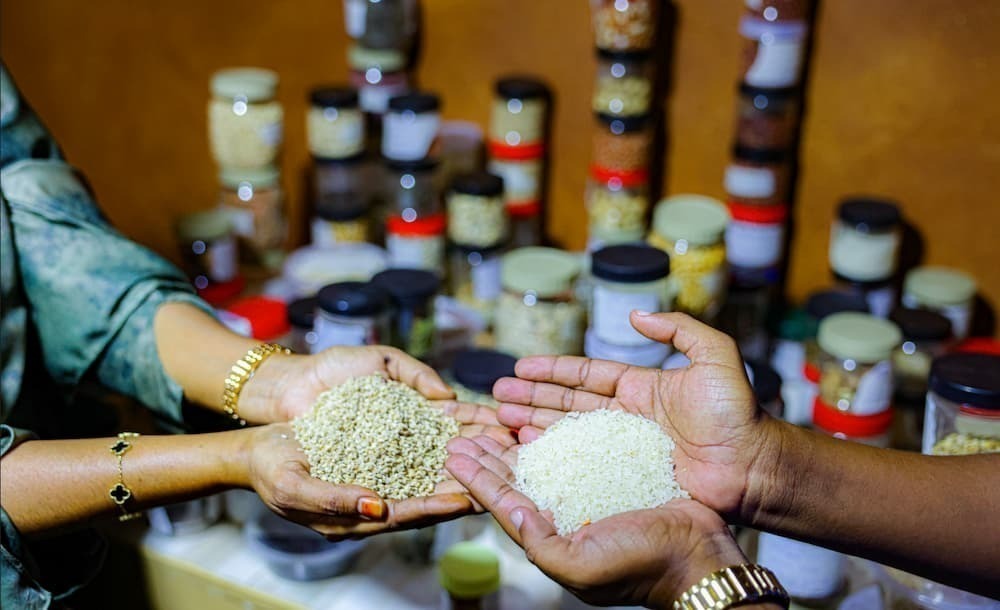
Despite being a biodiversity hotspot, with over half of its plant species indigenous, Somalia has long lacked seed banks and networks to conserve its unique natural heritage. Seeds are more than just a foundation for food security—they embody culture, resilience, and the promise of future harvests.
Turning Barren Land into a Living Biodiversity Classroom
In a significant step toward strengthening Somalia’s climate resilience and preserving its agricultural heritage, the International Organization for Migration (IOM), in partnership with City University of Mogadishu and Nuros9 Solutions, launched the country’s first indigenous seed bank since the civil war, with Resilience Design (RD) playing a critical role in establishing sustainable seed networks.
In November 2024, an RD training was conducted at the City University of Mogadishu, along with the establishment of a demonstration site.

On an empty 70-by-20-meter plot, 28 participants—including students and staff—put Resilience Design into practice. Guided by Warren Brush, co-founder of Resilience Design Consulting, they reshaped degraded soil into half-moon plots to capture rainfall and enhance soil fertility. Composting, cover cropping, and reduced tillage techniques were introduced, transforming once dry, lifeless ground into productive farmland.

Within months, the transformation was remarkable. By May 2025, the demonstration site was flourishing. On 14 May, seeds were harvested, preserved at the university’s newly constructed seed bank, and shared with communities and seed networks in Balcad and Jowhar. What began as a training exercise quickly evolved into a biodiversity hub — Somalia’s first national pilot indigenous seed bank — a living example of resilience, knowledge sharing, and sustainable food systems.


Launching Somalia’s First National Pilot Indigenous Seed Bank
Somalia’s first indigenous seedbank since the civil war was launched at City University of Mogadishu in June 2025, the new facility will be a central hub for preserving indigenous seeds, protecting biodiversity and regenerating native plant species.
Somalia’s farmers have noted how increasingly difficult it is for them to access seeds, a basic natural resource, as hybrid, one-time-growth seeds at the market are becoming more expensive and of unreliable quality, even in areas like Jowhar, often cited as the “breadbasket of Somalia”.

At the same time, there are few resources to support famers to save their own indigenous seeds which are most suited to their local environment. The seed bank is more than just a storage facility; it is a critical resource for empowering communities. It helps to conserve indigenous knowledge and farming practices, supports women as key custodians of seeds, enhances food sovereignty, and serves as a gateway to promoting regenerative farming and environmental restoration.
To raise awareness, prior to the launch, IOM facilitated a Student Biodiversity Competition in May 2025. Over 50 different seed varieties were collected by students from across Somalia, highlighting the country’s rich—yet vulnerable—biodiversity.

A Hub for Learning and Resilience
Today, the City University Seed Bank and Demonstration Site is far more than a farm—it is a living classroom and seed sanctuary. Students, Government actors and various partners come to learn hands-on practices in regenerative agriculture, Resilience Design, and environmental peacebuilding.
This initiative is restoring ecosystems, safeguarding Somalia’s indigenous seeds, strengthening land resilience, and reducing vulnerability to floods and droughts. Just as importantly, it is nurturing a culture of sustainability and collaboration, ensuring that Somalia’s biodiversity continues to sustain both people and the land for generations to come.

Community Seed Banks: Sowing Unity and Resilience
As the City University seed bank evolves into the central hub of a growing seed supply chain, IOM and its partners brought the model to life in rural communities through community seed banks.
In December 2024, through community engagement, IOM and Nuros9 Solutions began supporting the establishment of a community seed bank and seed networks in Balcad. Shared among five communities that had previously experienced protracted conflicts, the seed bank was designed as a collective resource—symbolizing unity, cooperation, and shared purpose.
Following a seed-saving training facilitated by IOM and Nuros9 Solutions, members of the community seed network achieved remarkable success. One of these success stories comes from Ms. Faiza, a member of the women’s networking group. Applying techniques such as seed selection, drying, labeling, and proper storage, she successfully preserved one kilogram of indigenous tomato seeds.
Demonstrating the spirit of collaboration, Ms. Faiza shared her surplus seeds with neighboring farmers, who later harvested and gifted her three kilograms of tomatoes in return. Some of the seeds were also contributed to the community seed bank for continued preservation and testing.
Ms. Faiza’s story stands as a powerful example of the impact of the Balcad seed bank and network, highlighting the strength of collective action and women-led innovation in rural agriculture. Her experience reaffirms that seeds are not only tools for sustainable farming and food security, but also catalysts for community resilience, social cohesion, and peacebuilding.
Through the simple act of sharing seeds, communities once divided are now working together—building trust, reducing dependency, and cultivating a more stable and self-reliant future.
-
.jpg) Resilience Design site planning in Balcad. Photo: © IOM 2024
Resilience Design site planning in Balcad. Photo: © IOM 2024 -
.jpg) Resilience Design for smallholder farmers in Balcad. Photo: © IOM 2024
Resilience Design for smallholder farmers in Balcad. Photo: © IOM 2024
Next Steps: Expanding the Network
IOM is now collaborating with local authorities, implementation partners, and universities to expand the seed bank and seed network initiative to Jowhar and other regions. The most recent collaboration—a Resilience Design (RD) training at Zamzam University of Science & Technology in Jowhar, led by the Hirshabelle Ministry of Agriculture and Irrigation and supported by IOM—brought together students, local farmers, and community members, fostering knowledge, collaboration, and local ownership.
By investing in biodiversity and resilience today, Somali communities are safeguarding the seeds—literal and symbolic—of a sustainable and peaceful tomorrow.
