News & Features | April 1, 2026
How RD Positively Changed My Harvest in Nakivale Refugee Settlement
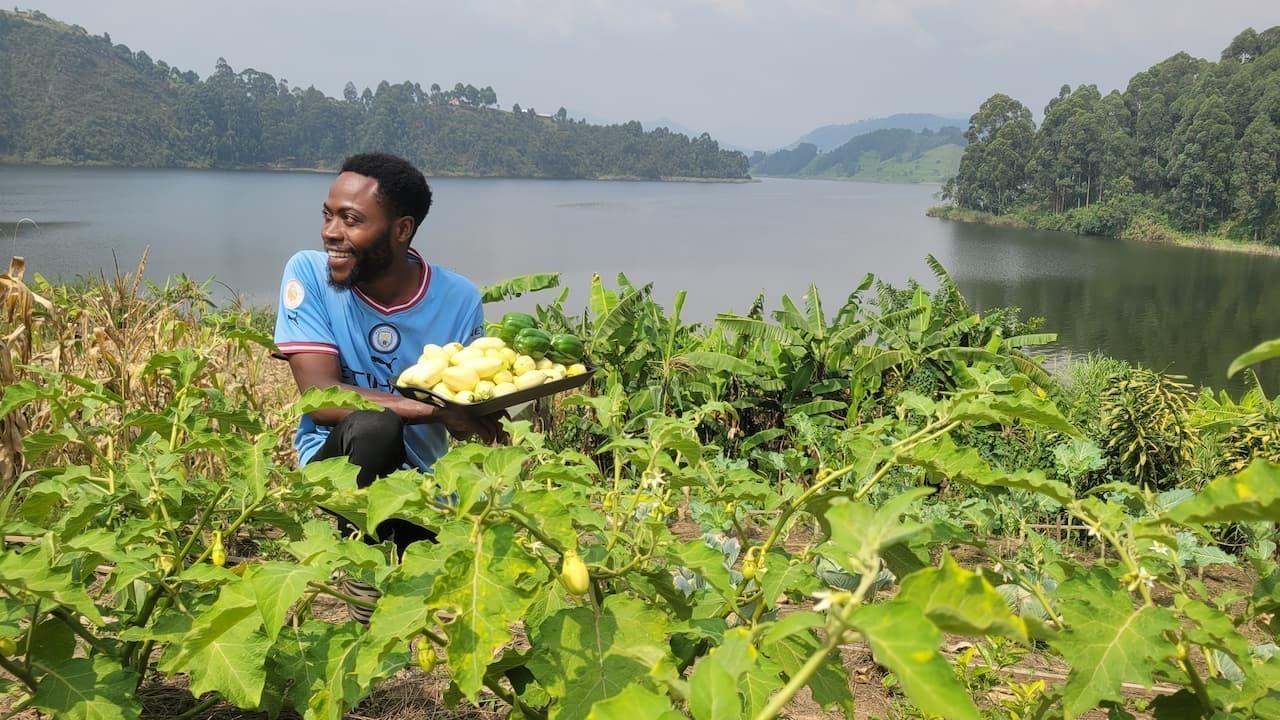
Harvests from an RD site in Nakivale Refugee Settlement. Credit: Kasole Chiza
Why I Introduced Resilience Design
Nakivale Refugee Settlement, located in Isingiro District, Southwest Uganda, was established in 1958 and is one of Africa’s oldest refugee settlements. Home to over 100,000 refugees from Somalia, DRC, Burundi and surrounding countries, it faces recurrent agricultural challenges. Unstable climate conditions, irregular rainfall, and prolonged dry spells often result in poor harvests. Because of this, many families depend on external markets and humanitarian assistance to meet their food needs.
A few months ago, I introduced Resilience Design (RD) into my community farming activities. It was a new approach for us: not just a farming technique, but a way of designing agricultural systems that can survive and adapt to shocks such as drought, food shortages, and economic hardship.

Starting Small, Despite Challenges
I began implementation on a very small plot of land, following the RD principle of "start small and simple." The initial challenges were significant:
- Lack of proper farming equipment
- Limited access to quality seeds
- Climate uncertainty
- Limited experience with regenerative practices
Rather than focusing only on increasing yield, I designed the farm as a whole, interconnected system. My objective was to build a farming system that restores soil health, conserves water, and improves productivity over time.
I prioritized soil conservation techniques, water harvesting strategies, agroforestry integration, and compost production.
-
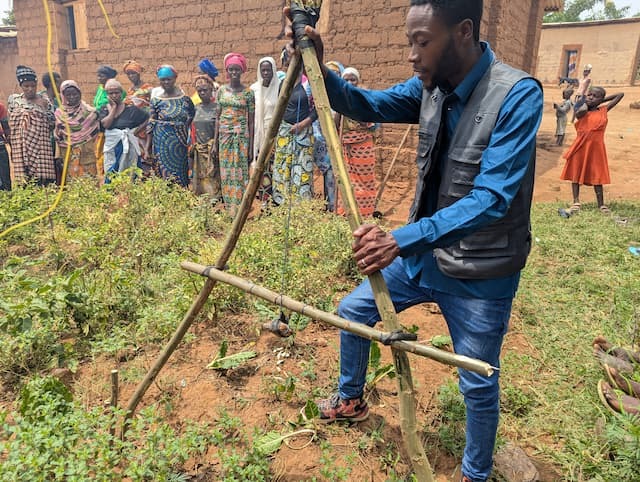 Using an A-frame to map the contour of the site before beginning earthworks. Credit: Kasole Chiza
 -
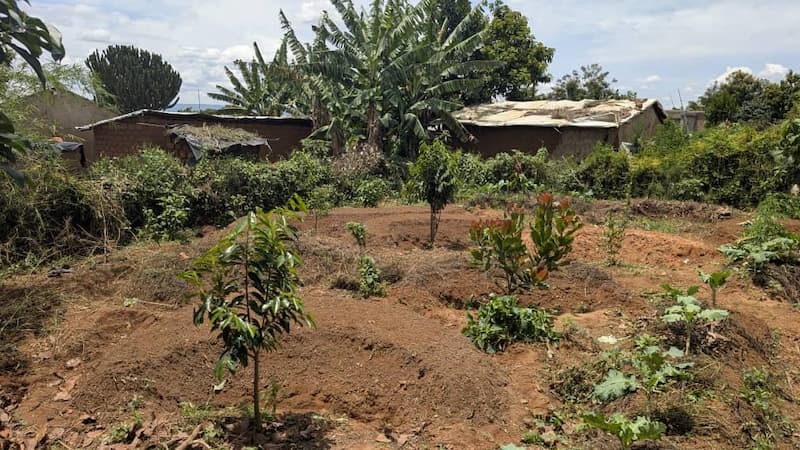 Smile berms around primary trees to help nourish the trees and slow, spread, sink and save rainwater. Credit: Kasole Chiza
 -
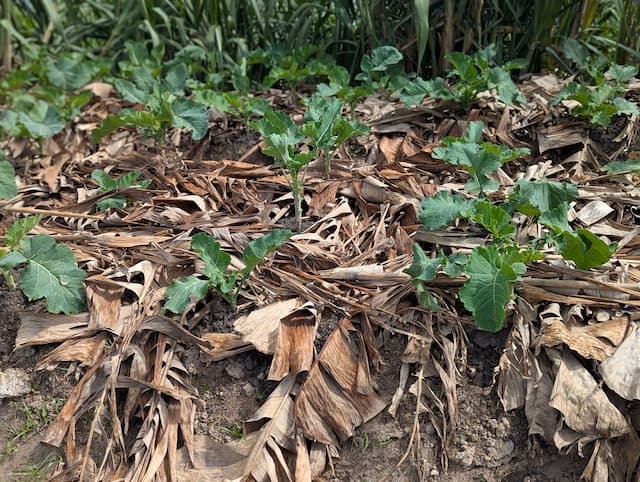 Mulches to protect the soil from erosion and sun. Credit: Kasole Chiza
Visible Results and Increased Production
After several months, the changes became clear. The soil retained moisture for longer periods. Crop health improved significantly. Production increased beyond expectations, even under unstable weather conditions.
These improvements were not accidental, they were the result of Resilience Design. This experience demonstrated that Resilience Design can be practical and effective even in refugee settlement contexts with limited resources.

Engaging the Community
Following these early results, I began working more closely with members of my community in Nakivale to introduce and promote RD principles more broadly.
Through hands-on training sessions and practical demonstrations, we focused on:
- Strengthening soil health
- Capturing and managing rainwater
- Integrating trees and perennial crops for long-term sustainability
- Reducing dependency on external agricultural inputs
The goal is to empower families to become more self-reliant while managing natural resources responsibly and sustainably.
-
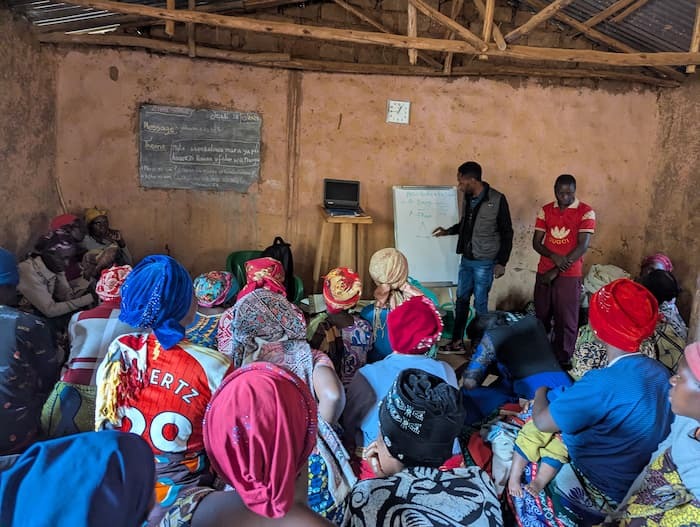 RD training with Nakivale community members. Credit: Kasole Chiza
 -
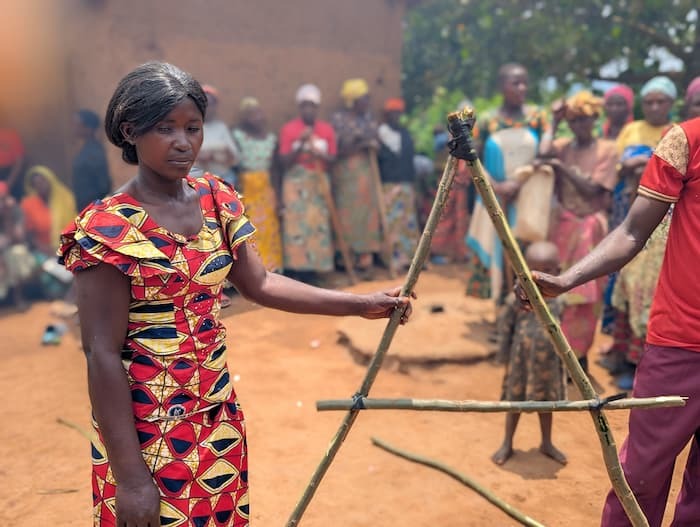 Community member learning to build an A-frame level. Credit: Kasole Chiza
Lessons Learned and Looking Ahead
Implementing Resilience Design in a refugee settlement comes with challenges such as limited land access, scarcity of tools, and climate variability. However, we are learning that resilience does not require large-scale infrastructure it requires thoughtful design, local adaptation, and consistent community engagement.
Even small plots of land can generate meaningful impact when systems are designed intentionally.
This initiative is still growing, and I look forward to learning from and contributing to the Global Resilience Design community as we continue strengthening local food systems in Nakivale.