In many rural communities across Zambia, climate change is no longer a distant concept, it is a daily reality. Erratic rainfall, prolonged dry spells, and declining soil fertility continue to affect how families grow food and sustain their livelihoods.
It is within this context that Climate Resilient Agroecological Hubs (CRAH) were introduced as an innovation, developed within World Vision Zambia—not as another project, but as living spaces for Resilience Design (RD) learning, experimentation, and transformation.
Where It Started
CRAH began as an RD innovation designed to bridge the gap between knowledge and practice. While many farmers and schools receive training on climate-smart agriculture, adoption often remains low due to limited opportunities to see, test, and adapt practices in real-life conditions.
The idea was simple but powerful:
create shared learning hubs where communities and schools learn together, by doing.

With initial innovation funding, the plan was to establish four hubs across selected Area Programs in Zambia, each consisting of a school site and a community site.
The CRAH model brings together multiple RD-related practices into one integrated system: Permagardens, food forests, nitrogen-fixing trees, soil health improvement, rainwater harvesting, and digital tools such as mobile-based advisory platforms. Together, these elements create a living system where communities and schools learn, adapt, and innovate in real time.
What Has Emerged
Today, that vision has grown beyond expectation.
Five fully functional CRAH hubs have now been established across Zambia—spanning all three agroecological zones. Each hub brings together students, teachers, farmers, and community leaders in a shared journey of RD learning and resilience building.
-
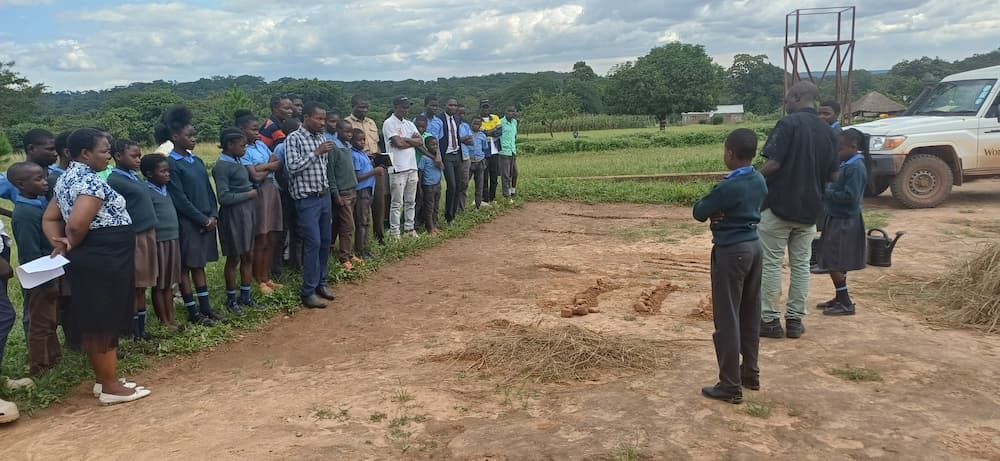 CRAH students conducting a sponge demonstration for community members. Credit: Ron Walis
 -
.jpg) Children replicating half moons and teaching their parents. Credit: Mr Sondoi
Children replicating half moons and teaching their parents. Credit: Mr Sondoi -
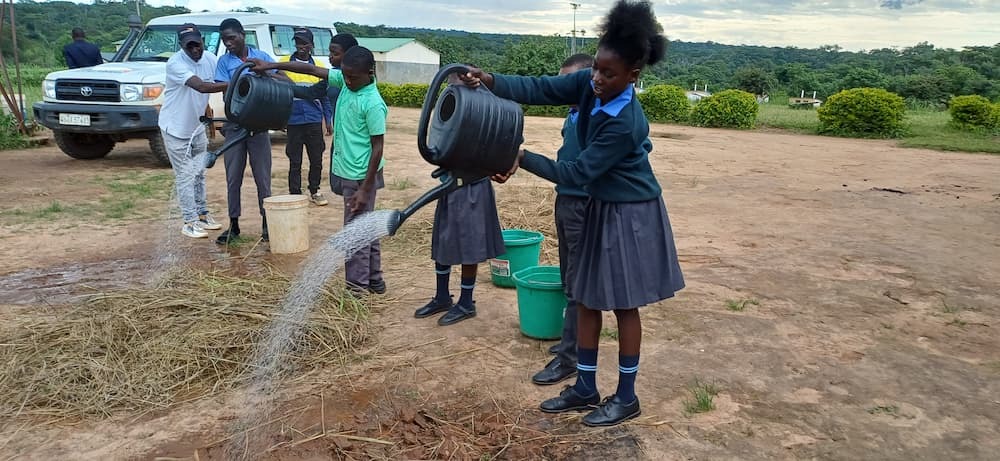 Sponge demonstrations are a great way for community members to see the potential of RD on a small scale. Credit: Ron Walis
At these hubs, the land itself has become the teacher. Communities are implementing:
- Permagardens for household nutrition
- Food forests for long-term sustainability
- Agroforestry systems to restore soil health
- Regenerative agriculture practices
- Nutrient recycling techniques
These are not static demonstration plots. They are active, evolving systems, shaped by local conditions and knowledge.
Children as Change Agents

One of the most powerful outcomes of CRAH has been the role of children.
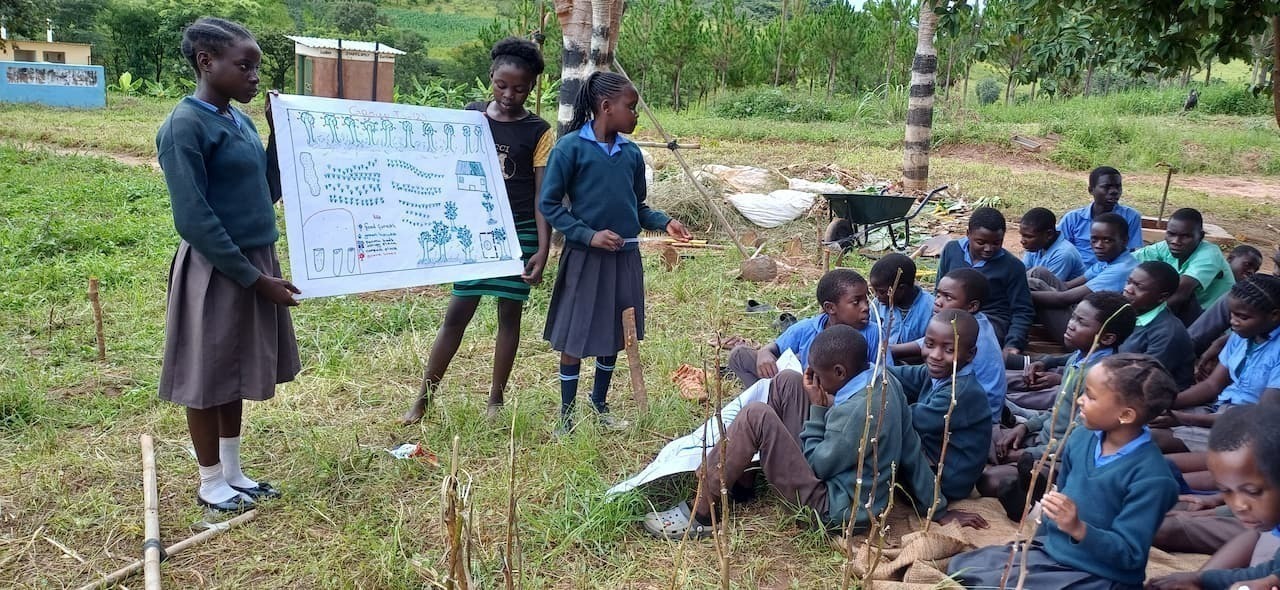
At school sites, learners are not just participants—they are becoming climate resilience champions. After learning techniques such as water harvesting and soil conservation, some children have gone on to replicate these practices at home, even teaching their parents.
In one instance, a group of learners began constructing half-moons to reduce flooding at their school. Soon after, parents joined them, learning directly from their children.
This reversal of roles—where children become teachers—is quietly transforming how knowledge flows within communities.
Designing for Diversity
Zambia’s landscapes are diverse, and so are the challenges communities face. CRAH hubs reflect this reality.
Each hub is designed according to its agroecological context, ensuring that solutions are locally relevant. In some areas, the focus is on water retention and soil conservation; in others, on restoring degraded land or protecting riverbanks.
At one community site, riparian protection measures have been introduced to safeguard water sources—demonstrating how resilience goes beyond farming to include ecosystem restoration.

More Than Sites — A System of Learning
What makes CRAH unique is not just the practices, but the connections it creates.
Each hub links:
- Schools and communities
- Theory and practice
- Traditional knowledge and new ideas
Monthly exchange visits are enabling farmers and pupils to learn from one another, allowing innovation to spread organically.
Looking Ahead

CRAH has moved from concept to reality in a short period of time. What began as an innovation is now demonstrating how communities can design and build their own resilience through practical, locally adapted solutions.
The opportunity now is clear:
to deepen impact, strengthen these hubs as centres of learning, and expand the approach so that more communities can adapt, innovate, and thrive in the face of climate change.