News & Features | July 22, 2026
From Bare Land to Living Systems
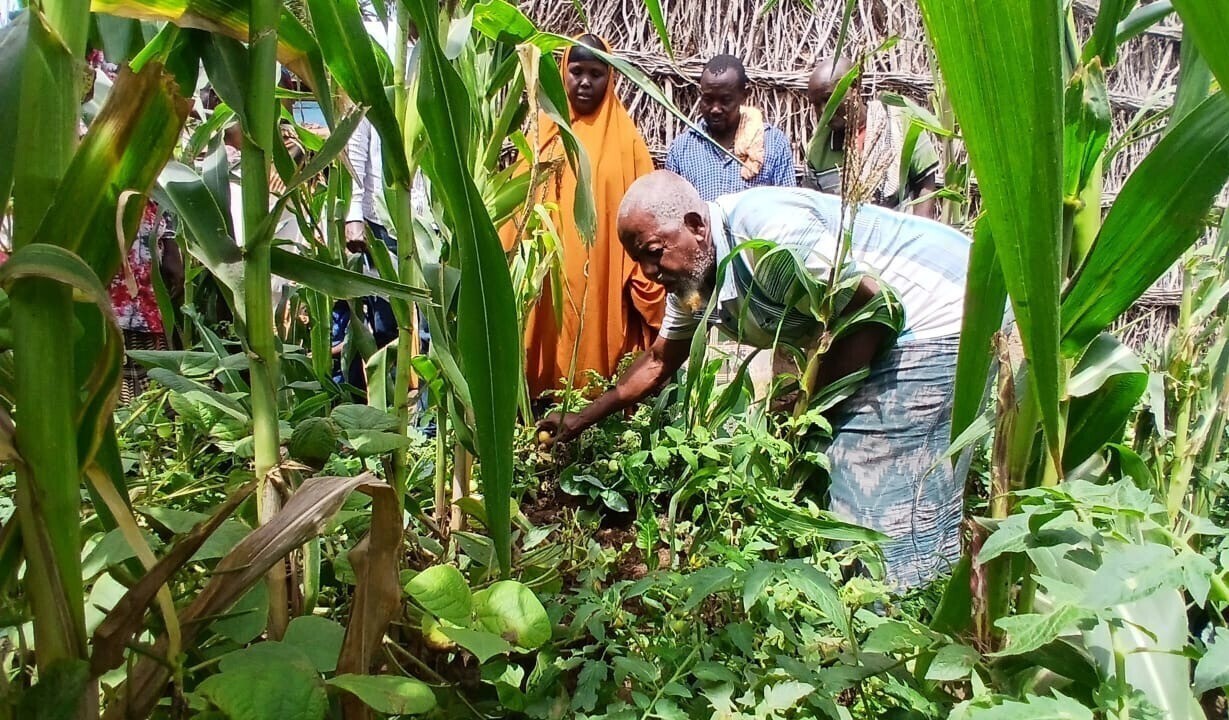
A Resilience Design lead farmer mentors his neighbors within his farm in July 2026. Credit: ADRO
In Bareey Village, Jowhar District, household scale Resilience Design is demonstrating a simple but powerful principle: Communities are not passive recipients of resilience solutions. They are the primary designers, implementers and stewards of the systems that sustain them.
Through the FCDO-funded RAF project under RESTORE/JOSP, FAO Somalia and implementing partner ADRO have been working with communities in Jowhar to apply Resilience Design (RD) at the household level.
A Landscape Shaped by Crisis and Opportunity
Bareey village sits within Jowhar District in Middle Shabelle, one of Somalia’s riverine agricultural food baskets, where the promise of the Shabelle River has long been constrained by fragile water control systems, recurrent climate shocks, conflict, displacement and the erosion of rural livelihoods. Communities here have lived through repeated cycles of floods and droughts leading to crop losses, depleted water sources, food insecurity and reduced income opportunities. Over successive crisis cycles, many families have become accustomed to external humanitarian assistance, including food and cash support, water and sanitation services, agricultural inputs, and emergency livelihood support.
FAO and FCDO are working in this area because Jowhar is not only vulnerable; it is also strategically important for Somalia’s food security and resilience. The aim of the household-scale Resilience Design is to support these communities to move beyond repeated need for external assistance toward community-led recovery–by working with households to redesign small spaces, harvest water, restore soil, diversify food production and reclaim their role as stewards of a renewed riverine landscape.
Designing Resilience at the Household Scale
The RD Approach begins not with inputs, but with observation of how water moves, where soil is exposed, what resources already exist, what households eat, what labor is available, and how small spaces can be redesigned to meet daily needs.

The work in Bareey started with land that was largely bare, degraded and underutilized. These household spaces offered limited contribution to nutrition, food production or resilience. However, once communities began to read their own landscapes differently, those same spaces became sites of possibility.
Farmers shaped the land with water harvesting structures, double dug beds, smile berms, mulch, compost and locally available materials, including sawdust that they previously discarded aimlessly by the roadside! They began integrating cereals, vegetables, legumes and trees into small, but productive household plots. What emerged was not simply a garden, but a living household system designed around water, soil, biodiversity, food and dignity.


To date, the project has engaged 300 households, organized through 15 Resilience Design groups, with 241 permagardens established by May 2026. As of July 2026, communities have already started harvesting diverse crops including pumpkin, kale, spinach, mung bean, cowpea and maize. These early harvests matter not only because they improve access to food, but because they signal a deeper shift: Households are seeing that land once considered unproductive can be restored, managed and made useful again.
This is where the real power of Resilience Design becomes visible. Technical practices are important, but the transformation is not only technical. It is social, behavioral and ecological, and therefore adaptive. Communities are moving from waiting for external support to actively shaping their own productive spaces. Farmers are learning from one another. Neighbours are observing, asking questions and beginning to replicate. Household plots are becoming informal classrooms where knowledge is shared through practice rather than instruction alone.
-
.JPG) This family showcases their bounty vegetable harvest just under 2 months of transplanting their seedlings. Credit: ADRO
This family showcases their bounty vegetable harvest just under 2 months of transplanting their seedlings. Credit: ADRO -
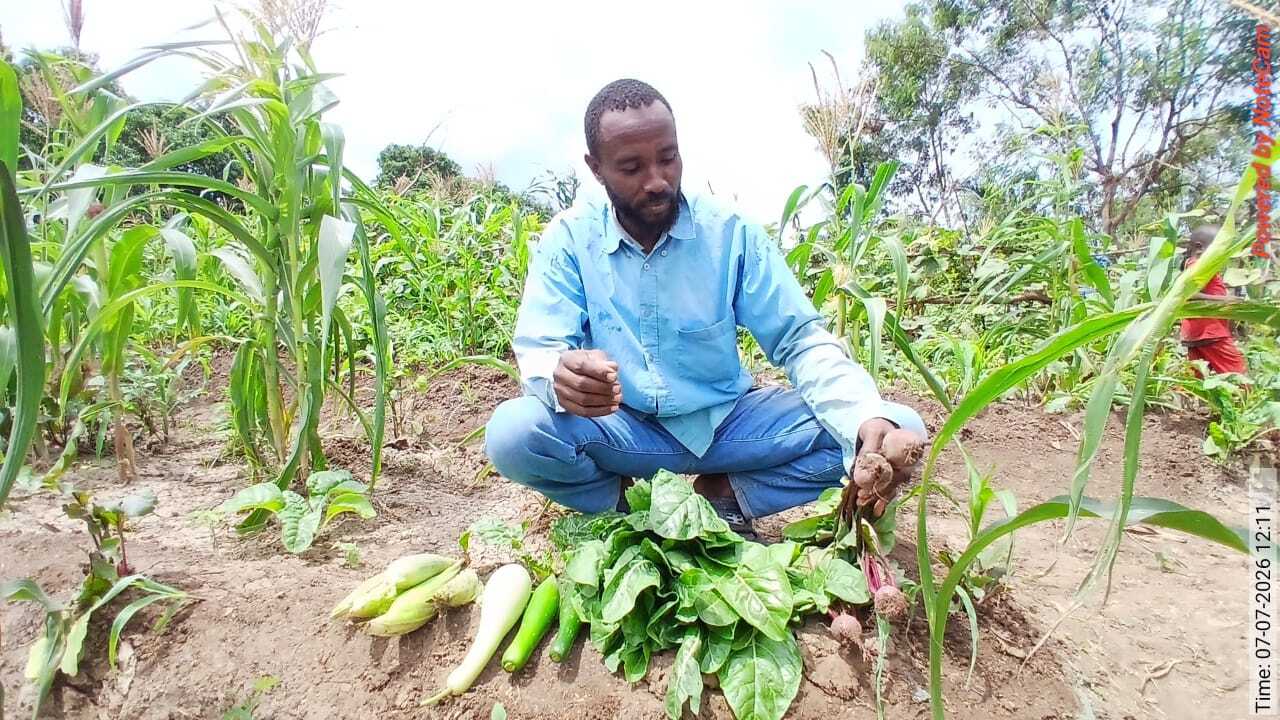 One of the project participants showcases his harvest from what he previously thought was barren land. Credit: ADRO
Turning Experience into Learning
Key lessons emerged from this project related to applying RD at the household level.
-
Community mobilization requires patience, honesty and proximity. In contexts where households have experienced repeated shocks and long histories of external assistance, dependency can shape expectations. This makes targeting, transparent communication and close community engagement essential. Resilience Design cannot be rushed in as an activity. It must be introduced as a process of trust building and shared responsibility, where communities understand that the value lies not only in what is provided, but in what they can design, adapt and sustain.
-
Centering communities in the design process reduces costs and increases ownership. When farmers are part of assessing what is locally available–mulch, organic matter, fencing materials, local seed knowledge, labor arrangements, shade, water flow and household space–the design becomes more practical and more affordable. More importantly, it becomes theirs. The enthusiasm to engage grows when communities recognize their own knowledge and resources inside the solution.
-
Resilience is built through preparation, not through emergency response alone. In Jowhar, the preparation of water harvesting structures before the rains proved critical. Dry season earthworks allowed households to shape land in anticipation of rainfall, rather than reacting after the rains had already arrived. Staggered planting of diverse crops also emerged as an important practice, supporting more continuous production and reducing the risk of relying on one crop or one harvest window.
-
Training alone is not enough to sustain uptake: mentorship has been equally central. Farmers need follow-up, troubleshooting, refresher sessions and encouragement as they adapt practices to real household conditions. Continued mentorship and monitoring help maintain momentum, strengthen farmer confidence, and support the spread of practices beyond direct project participants. In Bareey, this has been especially important as neighbors begin to replicate what they see working. In the phase of shrinking funding, the challenge for us is to find ways to employ programmatic ways of engaging these communities, other than offering short-term injections of presence and resources through project-based approaches.
-
Storytelling itself is a design tool. Collecting stories from farmers is not only a communications exercise: it creates a moment of reflection. It allows communities, partners and technical teams to ask: What is changing? What is working? What is spreading? What still needs to be adapted? In this sense, stories become part of the feedback loop for improving implementation. They help shift attention from activities delivered to change observed. If you have trained with Warren and Tom, you most probably have their words ringing in your ear right now as you read this, “Put on your Resilience Design glasses and never take them off,” and, “Design is never done!” ☺
The Path Forward
The experience in Jowhar is still emerging, but it offers a strong message for fragile and climate-affected contexts: household-scale systems can become powerful entry points for resilience. Small spaces, when redesigned with ecological purpose and community leadership, can support nutrition, restore degraded land, strengthen confidence, and catalyse local learning.
The communities in Bareey are showing that resilience is not built for people. It is built with them, and ultimately, by them. The role of external actors is to accompany, resource and learn alongside communities, while steadily strengthening the stewardship capacity of those who understand the land most intimately and will remain to care for it long after a project ends.

In Jowhar, the visible transformation is green: maize rising, leafy vegetables growing, legumes harvested, soils covered, and water better held in the land. But the deeper transformation is quieter and more significant: it is the shift from bare land to living systems, and from external assistance to community stewardship.
