
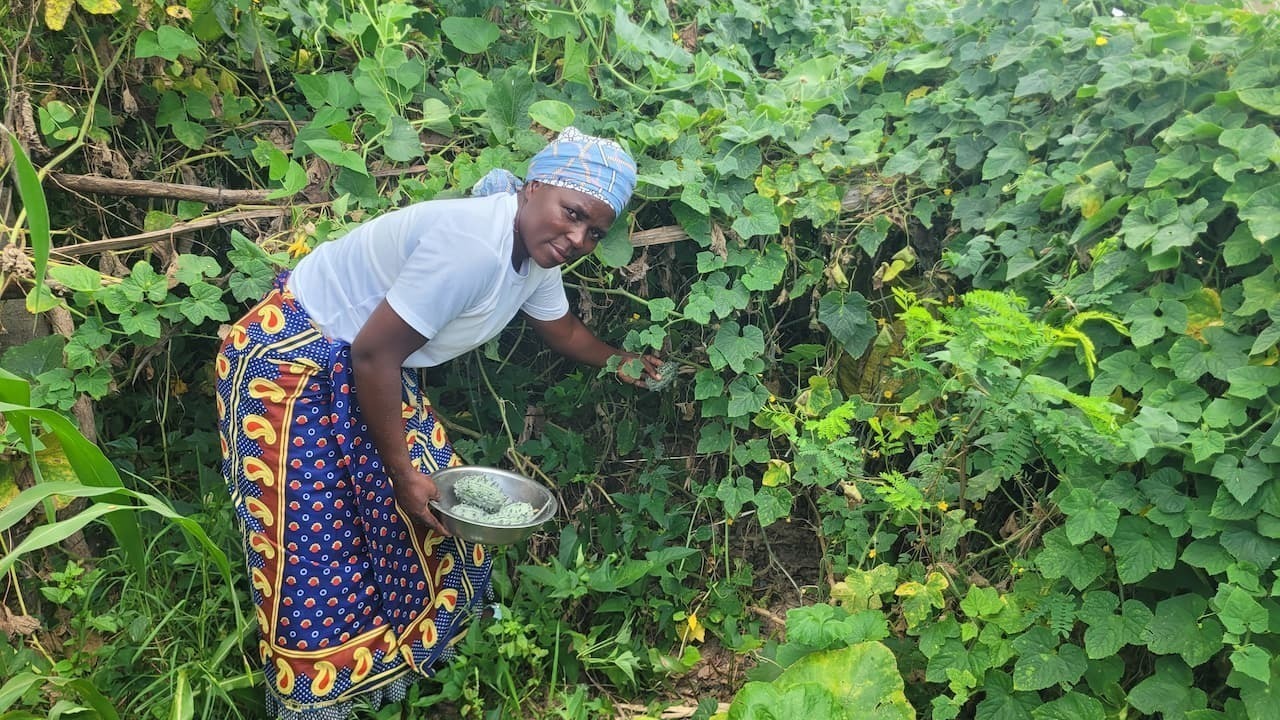
With the SRP, you do not fork money out of your pocket, but money gets in your pocket while you eat healthy and plentiful foods.
In Zimbabwe's Buhera and Tsholotsho districts, farming communities are facing increasingly unpredictable weather patterns. Heavy rainfall, prolonged dry spells, soil degradation, and declining productivity continue to threaten household food and nutrition security.
To help communities adapt to these challenges, the Sustainable Roots Project (SRP), implemented by CARE Zimbabwe, Nutrition Action Zimbabwe, and ORAP, introduced the Resilience Design (RD) Approach following a Training of Trainers programme facilitated by African Women Rising in Uganda.
Building Momentum: From Training to Action
In 2025, SRP's Organic and Conservation Agriculture (OCA) Specialist participated in the RD Training of Trainers programme at Lok Neno in Uganda. Upon returning to Zimbabwe, the learning was rapidly cascaded to programme staff, government extension officers, lead farmers, and community members across Buhera and Tsholotsho districts.
The trainings combined RD with agroecological principles such as biodiversity, resilience and synergistic farming systems. The SRP also trained the lead farmers on the importance of livestock integration as a cornerstone of resilient farming systems, encouraging them to create mutually reinforcing relationships between crops, soil, animals, and households.
Equipped with these new skills, lead farmers began establishing RD structures including bioswales, smile berms (half-moons), double-dug permagarden beds and improved interlocking planting holes (Pfumvudza/Intwasa), to slow, spread, sink and store water while improving soil health and productivity. Farmers also began integrating small livestock such as goats, sheep, chickens, and to a larger extent, cattle, for both manure and draft purposes. These integrated crop-livestock systems designs enhanced productivity while reducing dependence on external inputs and strengthened farm resilience.
Within a few months, eighty lead farmers had established permagardens and demonstration sites across Buhera and Tsholotsho, creating local learning hubs where neighbouring farmers could observe RD principles in practice.
A Test of Resilience
The 2025/26 agricultural season quickly put these new systems to the test.
Buhera received unusually heavy rainfall early in the season, with cumulative rainfall reaching 638 mm by the end of December. Excess rainfall caused nutrient leaching across many conventional fields. Soon afterwards, the rains stopped abruptly and an intense hot and dry spell lasting several weeks followed.
Farmers without RD structures witnessed declining crop performance as moisture disappeared and nutrients had already been washed away.
However, farmers who had implemented RD structures began observing a different reality: Bioswales retained water, mulched fields reduced evaporation, smile berms harvested runoff, and integrated systems continued producing food despite the extreme weather conditions.
Farmer exchange visits organised between Wards 7 and 9 in Buhera district provided a clear comparison. Participants observed thriving crops on RD-managed plots, while neighbouring fields without RD interventions showed visible signs of nutrient loss, erosion, and moisture stress.
For many participants, this was the moment Resilience Design moved from theory to reality.


A Family's Resilience Story Begins with a Smile Berm
Smile berm structures capture rainwater while supporting fruit trees, vegetables, sugar beans, and pigeon peas in the same space. The nitrogen-fixing legumes contribute to soil fertility, while the berms improve water retention and support year-round production.

During a monitoring visit, the family proudly demonstrated how the system had improved both crop production and fruit quality. While sharing fruits harvested from the berm-supported trees, they explained that moisture retention and improved soil fertility had contributed to healthier trees and sweeter fruit.
Their story beautifully illustrates a core Resilience Design principle: every element in a system should perform multiple functions.
The smile berms harvest water, support tree establishment, increase production, improve soil fertility, create shade and strengthen household nutrition all within the same space.
Designing Diversity Around the Homestead
The exchange visits also revealed how families are moving beyond monocropping toward intentionally designed, diverse food systems.
One of the lead farmer's sons explained how the family had protected their smile berm area from livestock while integrating multiple crops together, including orange trees, sugar beans, pumpkins and chilies. Rather than allocating separate spaces for each enterprise, the family had created a productive micro-landscape where different components support and complement one another.
This biodiversity reflects an important lesson from the Uganda training, where participants learned that diversity is not simply about growing many crops. Diversity is about creating ecological interactions that improve resilience, nutrient cycling, food security and water management.
The same design philosophy can also be seen in permagardens established throughout Buhera and Tsholotsho where indigenous vegetables, pumpkins, horned cucumbers, tomatoes, maize and legumes were intensively planted within double-dug beds enriched with organic matter and locally available inputs.
Resilience at the Household Level
Perhaps the most powerful testimony came not from the fields but from the family's doorstep.
Just outside her home, the lead farmer showed visitors another smile berm where she was already harvesting tomatoes for household consumption. Standing beside the thriving plants, she reflected on how much life had changed since implementing Resilience Design: “With SRP, you do not fork money out of your pocket, but money gets in your pocket while you eat healthy and plentiful foods.”
Her statement captures the essence of resilience: RD is helping households produce their own nutritious food, reduce expenses, generating income and strengthening their ability to withstand climate shocks simultaneously.
Similar sentiments emerged throughout the exchange visits, such as this remark from a Lead farmer from Ward 7:
"RD is very effective. It helps us plan and organise our homesteads in a way that maximises both crop and livestock production. I wonder why you (SRP) told us to do only 10%, and not do the whole fields."
Farmers as Champions of Resilience
The most significant outcome has been the emergence of farmers as trainers and ambassadors of Resilience Design. Lead farmers who initially received training are now hosting exchange visits, demonstrating RD structures, sharing practical experiences, and encouraging wider adoption throughout their communities. Their farms have become living classrooms where neighbouring households can witness results firsthand.

As participants walked through productive fields, thriving permagardens and carefully designed smile berm systems, they witnessed the practical benefits of Resilience Design under some of the most challenging weather conditions experienced in recent years.
Lasting Results
What began as a training programme in Uganda has evolved into a growing movement of farmer-led innovation in Zimbabwe. The experience from Buhera and Tsholotsho demonstrates that Resilience Design is more than a set of technical interventions.
RD is a practical approach that enables communities to manage climate shocks, improve food and nutrition security, restore soil health, and strengthen livelihoods.
As climate variability continues to challenge farming communities across Southern Africa, farmers in Zimbabwe are showing that locally led innovation, combined with Resilience Design principles, can create productive, resilient, and sustainable farming systems that benefit both people and landscapes.
Next Steps
Following the successful piloting of RD in four wards (two in Buhera and two in Tsholotsho), SRP is already deepening and scaling up the approach. Continued support is being provided in the pilot wards to strengthen adoption and impact, while six additional wards have been earmarked for expansion, bringing the total target to ten wards. To accelerate outreach, each trained lead farmer will cascade RD training to at least 20 farmers within their respective groups, creating a multiplier effect that supports wider dissemination and uptake of resilience design principles
When knowledge is effectively cascaded, owned by communities and tested under real-world conditions, Resilience Design can deliver results that are both visible and transformative.
